
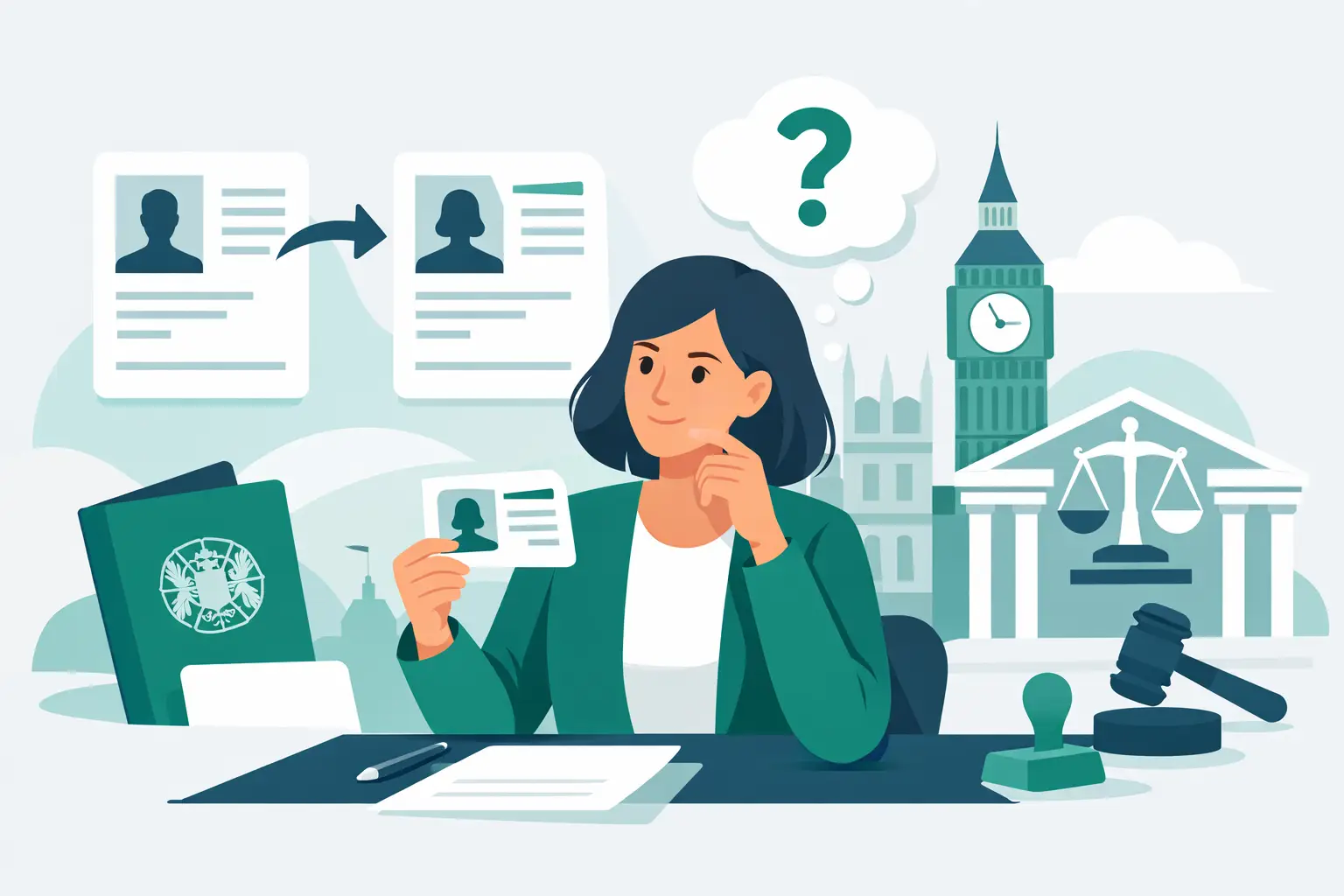
If you are asking, can I change my name, the short answer is yes. In the UK, most people can change their name without going through a solicitor or a complicated court process. What tends to cause stress is not whether you are allowed to do it, but how to do it properly so passports, driving licences, banks and employers all accept the change.
That matters because a name change is rarely just paperwork. Sometimes it follows marriage or divorce. Sometimes it reflects family circumstances. Sometimes it is about finally using the name that fits who you are. Whatever the reason, the process should feel clear, lawful and manageable.
Can I change my name legally?
Yes. In the UK, you are generally free to change your name as long as you are not doing it for fraud or to avoid your legal responsibilities. For most adults, the standard way to create formal evidence of a name change is by using a deed poll.
A deed poll is a legal document that shows you have given up your old name, adopted a new one, and want to be known by that new name for all purposes. Organisations use it as proof when updating your records. That includes places such as HM Passport Office, DVLA, banks, HMRC, the NHS, schools and universities.
People often assume they need a solicitor, a court order or a special government approval. In most cases, they do not. The key is having the right document and following the update process with each organisation.
Who can change their name?
Most people aged 16 or over can change their own name. Parents or guardians can also change a child’s name, although the rules are more sensitive because consent matters.
For adults, the process is usually straightforward. For children, it depends on who has parental responsibility and whether everyone with that responsibility agrees. If there is disagreement, the route can become more complex and legal advice may be needed.
The reasons for changing a name vary widely. You might want to take a partner’s surname, stop using a former married name, choose a different family name, correct a long-used informal name, or align your documents with your identity. The reason is personal, but the practical requirement stays the same – you need accepted documentary proof.
What kind of name can you choose?
In most cases, you can choose the name you want to use. There is no approved list of acceptable names, but there are limits. A new name must not be chosen for dishonest purposes, and organisations may raise concerns if a name includes numbers, symbols, offensive wording, or anything likely to cause confusion.
This is one of those areas where it depends. A name might be legally usable in principle but still create delays if it does not fit neatly into government or banking systems. Very unusual formatting, punctuation or titles can cause practical issues even if your intention is genuine. If you want the smoothest possible update process, it usually helps to choose a name that institutions can record easily.
Do I need a deed poll to change my name?
Strictly speaking, UK law allows people to adopt a new name through use. In reality, that is not enough for most official records. If you want your passport, driving licence, bank accounts and employer records updated, a deed poll is usually the document that makes the process straightforward.
That is why deed poll remains the standard choice. It gives organisations a clear, recognised record of your decision. It also saves time. Instead of explaining your situation repeatedly, you can provide one formal document that supports each update.
There are different types of deed poll depending on your circumstances, including adult and child deed polls. If you need to send proof to several organisations at the same time, additional copies can be useful so you are not waiting for one document to be returned before moving on to the next task.
Enrolled or unenrolled deed poll – what is the difference?
This is where many people get stuck. An unenrolled deed poll is the most common option for everyday name changes. It is a valid legal document used to update records across major institutions. For most people, it is the practical route because it is faster, more private and easier to arrange.
An enrolled deed poll involves a formal court-based process and creates a public record. Some people assume that means it is more official. In everyday use, that is usually not necessary. The trade-off is privacy. If confidentiality matters to you, an unenrolled deed poll is often the better fit.
For many customers, the real priority is getting a legally recognised document accepted without delay. That is why a professionally prepared deed poll, backed by clear guidance and support, is often the simplest route.
How the process usually works
Once you decide on your new name, the next step is preparing your deed poll accurately. Details matter. If names are misspelt, poorly formatted or inconsistent with the records you need to update, the process can slow down.
After your deed poll is issued, you can begin notifying organisations. Many people start with photo ID because updated identity documents make the rest of the process easier. From there, you can update your bank, employer, HMRC, NHS records, school or university, and any other accounts or services in your old name.
Timing matters too. If you need your new name recognised quickly, a service that offers same-day processing and prompt delivery can make a real difference. The less time spent waiting for documents, the sooner you can start updating your records and moving on.
Can I change my name after marriage or divorce?
Yes, but the right document depends on what name you want to use. If you are simply taking a spouse’s surname after marriage, your marriage certificate may be enough for some updates. If you are changing to a name that is not directly shown by that certificate, you will usually need a deed poll.
After divorce, some organisations accept a combination of your marriage certificate and decree absolute or final order if you are returning to a previous surname. If you want a different name altogether, a deed poll is normally the clearest option.
This is one of the most common areas where people lose time. They assume one certificate will cover every situation, then discover a bank or government department wants something different. A deed poll often removes that uncertainty by giving you a single formal document to rely on.
Can I change my child’s name?
Yes, but extra care is needed. If a child is under 16, the application is normally made by a parent or guardian, and consent from everyone with parental responsibility may be required. Schools, GP records and passport authorities will expect the paperwork to match the child’s legal circumstances.
Where everyone agrees, the process can be straightforward. Where there is disagreement, it may not be. That does not mean it is impossible, but it does mean you should proceed carefully and make sure the documentation is prepared properly.
What happens after the deed poll is signed?
The document itself is the starting point, not the finish line. Once it is signed and witnessed correctly, you use it to tell organisations that your name has changed. Some will ask for an original document, while others may accept a certified or additional copy.
It helps to work methodically. Update your core identity records first, then move to financial, medical and educational records. Keep a simple checklist so nothing gets missed. Most people find the process becomes much easier once the first few changes are completed.
If you want a guided route, Change My Name provides deed poll documents with clear instructions, UK-based support and a money-back acceptance guarantee, which helps remove a lot of the uncertainty people feel at the start.
The question behind “can I change my name”
Most people are not really asking whether a name change is allowed. They are asking whether it will be accepted, whether it will be difficult, and whether they are going to get caught in endless admin. That is completely understandable.
The good news is that for most people, the process is far more straightforward than expected when the paperwork is prepared properly from the outset. A legally recognised deed poll, accurate details and a clear plan for updating records are usually what turn a stressful task into a manageable one.
If your current name no longer fits your life, there is no need to stay stuck in uncertainty. The right support can make the process feel exactly as it should – clear, respectful and firmly under your control.