
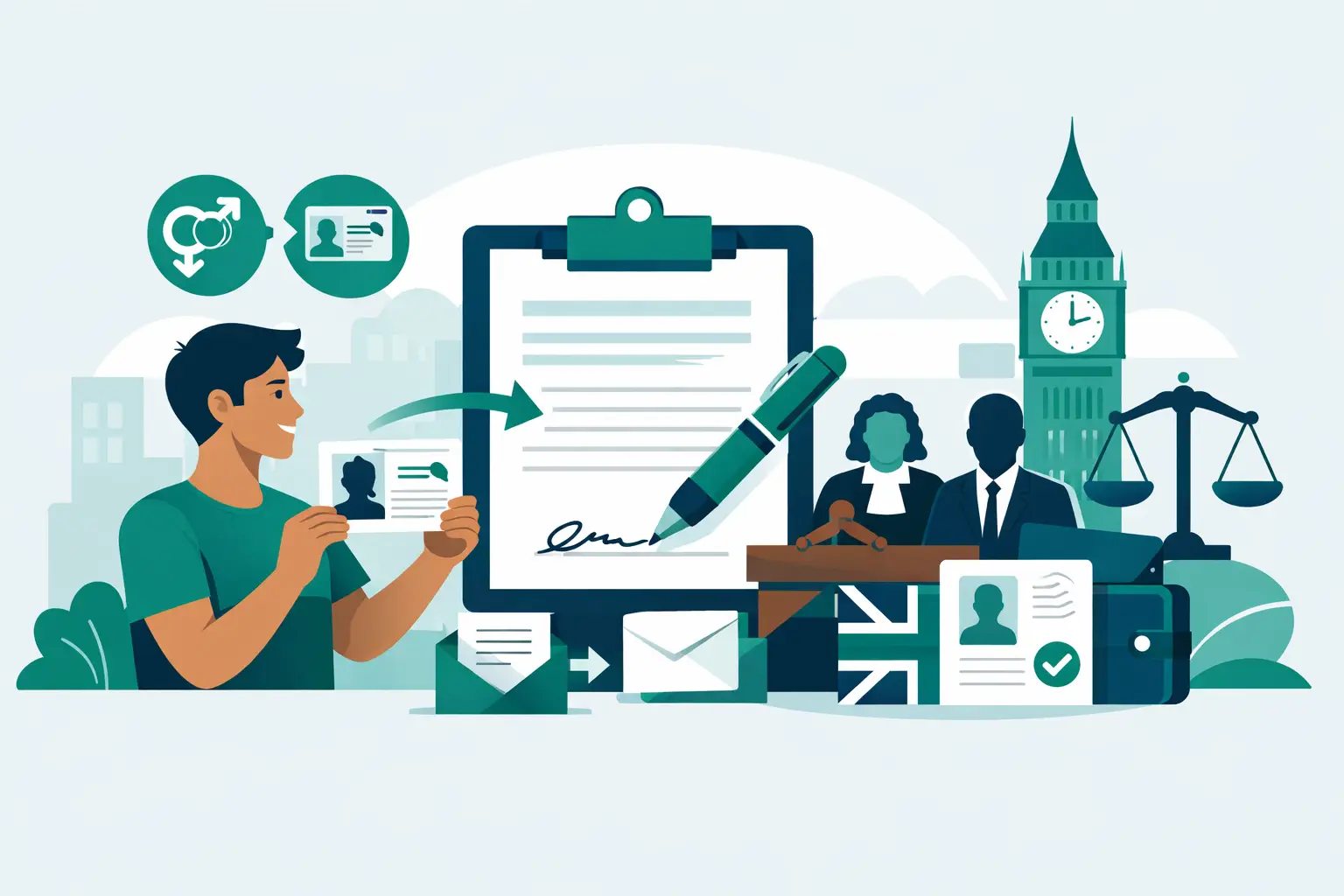
For many trans and non-binary people, changing your name is not a small admin task. It is often the point where everyday life starts to match who you are. The trans name change process can feel daunting at first, especially if you are unsure what counts as legal proof, which organisations to tell, or whether your documents will be accepted. The good news is that in the UK, the process is usually more straightforward than people expect.
What matters most is having the right document, completing it correctly, and then working through your records in a sensible order. You do not need to make the process harder than it needs to be.
How the trans name change process works
In the UK, most people changing their name use a deed poll. This is the document that confirms you have given up your old name for all purposes and adopted your new one. For transgender people, that usually means choosing the name you want to be known by and creating a deed poll that can be presented to official organisations.
A deed poll is commonly used to update your passport, driving licence, bank accounts, employer records and other personal documents. In practical terms, it is the foundation of your name change. Once that is in place, the rest of the process becomes a series of updates rather than a legal mystery.
This is where people often overcomplicate things. There is no single government office that changes everything for you at once. Instead, you prepare a legally recognised document and then use it to update each organisation in turn.
Start with your deed poll
The first step is preparing your deed poll accurately. Your new name must be written exactly as you want it to appear across your records. Consistency matters. If one version includes a middle name and another does not, or if spellings vary, you can create delays later.
You will also need the document to be properly executed. That means following the signing requirements so it can be accepted by the organisations that need to see it. This is one reason many people prefer a prepared deed poll rather than drafting their own from scratch. It removes uncertainty and gives you a document that looks formal, clear and ready to use.
For anyone feeling anxious about whether institutions will accept a name change linked to gender identity, reassurance matters. Most major organisations are familiar with deed polls and process these requests regularly. The key is not whether your reason is accepted, but whether your document is correct.
Which records to update first
After your deed poll is ready, the next stage of the trans name change process is deciding what to update first. There is no single perfect order for everyone, but some changes tend to make the rest easier.
Many people start with photo ID, especially a passport or driving licence. Once you have updated one major identity document, it often becomes simpler to change your details elsewhere. Banks, employers and other institutions may ask for identification as well as your deed poll, so having current ID can save time.
After that, it usually makes sense to update HMRC, your bank, your employer, your GP surgery and any educational records if relevant. Utility providers, mobile contracts, pension providers and insurers can follow. If you rent your home, your landlord or letting agent may also need updated details.
The trade-off is speed versus convenience. Some people want to notify every organisation at once and get it over with. Others prefer to deal with the most important records first and work through the rest in batches. Both approaches are valid. If the process feels emotionally heavy, doing it in stages can make it more manageable.
Passports, driving licences and official ID
Identity documents tend to carry the most weight in day-to-day life, so they deserve particular care. When updating a passport or driving licence, you will normally need your deed poll and any additional evidence required by that organisation.
This is also where some trans customers worry about the difference between changing a name and changing a gender marker. They are related, but they are not always handled in exactly the same way. A deed poll is generally used for the name change itself. A gender marker change may involve separate requirements depending on the document and the issuing body.
That distinction can be frustrating, but it is worth understanding early. If your immediate priority is being known by the correct name, your deed poll is the essential first step. Other updates can then follow according to each organisation’s rules.
Banks, work and everyday records
Once your formal ID is in progress, the next priority is usually the places where your name appears regularly in everyday life. Your bank, employer, payroll, pension provider and GP records are common examples.
These updates matter for more than convenience. They reduce the risk of being addressed by the wrong name in public settings, on payslips, at appointments or during routine security checks. That can make a real difference to confidence and privacy.
Employers and HR teams vary. Some are efficient and respectful; some need a nudge and clear documentation. If you are updating records at work, it often helps to ask not only for payroll changes but also email addresses, staff directories, ID cards and internal systems to be updated at the same time.
Banks can also differ in how quickly they process requests. Some accept copies, while others may ask to see an original document. It depends on their internal policy. This is one reason additional certified copies of your deed poll can be useful if you want to contact several institutions without waiting for one document to be returned.
The trans name change process for younger people
If the name change is for someone under 16, the process is different from an adult deed poll. A child name change usually requires consent from everyone with parental responsibility, or evidence showing why that is not needed or cannot be obtained.
For trans young people and their families, this can be one of the more sensitive areas. The legal side must be handled correctly, but the emotional side matters just as much. Clear paperwork helps, yet so does taking time to make sure schools, GP records and any support services are updated in a way that protects the child’s dignity.
If the young person is 16 or over, they can generally change their own name as an adult. That often makes the process more straightforward.
Common concerns about acceptance
A lot of hesitation comes from one fear: what if an organisation refuses the document? In most cases, that fear is bigger than the actual risk. Properly prepared deed poll documents are widely accepted across major UK institutions.
Problems are more likely to happen when documents are incomplete, names are inconsistent, signatures are missing, or the person submitting the request is not sure what the organisation has asked for. Good preparation solves most of this.
It also helps to keep a simple record of who you have contacted, when you sent documents and what response you received. If you are dealing with several updates at once, this can stop the process from becoming a blur.
Making the process feel manageable
The trans name change process is legal and administrative, but it is also personal. Some people feel relieved once the paperwork is underway. Others feel exhausted by the number of separate organisations involved. Both reactions are normal.
What usually helps is reducing friction wherever possible. Use the exact same version of your new name every time. Keep your documents together. Start with the records that affect daily life most. If you can, choose a service that gives you clear guidance, fast turnaround and documents prepared to meet the expectations of major institutions.
That is the value of a provider such as Change My Name. For people who want the process handled quickly and correctly, a professionally prepared deed poll can remove much of the uncertainty and help you move forward with confidence.
What to expect after your name change
Once your updates are in motion, there may be a short period where old and new names overlap across different systems. That is normal. Some organisations update records in days, while others take longer. It does not mean your deed poll is not valid.
During this stage, patience and consistency matter. If one organisation is slower than another, keep using the same supporting documents and the same spelling of your new name. Over time, your records catch up.
A name change will not solve every challenge that comes with being trans, but it can remove a daily source of stress and create a stronger sense of alignment between your identity and your paperwork. That is not a minor change. It is a practical step that can make ordinary life feel much more straightforward.
If you are ready to begin, focus on the next action rather than the whole list. One correct document, one update at a time, is often all it takes to turn a daunting process into a manageable one.